Comprehensive Edit
As a technical communicator, I am well-versed in the skills of writing, editing, and graphic design. The opportunity to use these varied skills in one document rarely comes along, but I believe this sample of a comprehensive edit shows what a vast difference the combination of all three can make.
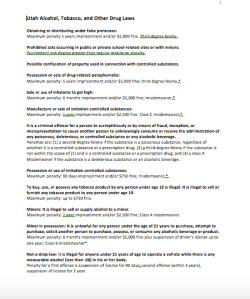
The original document was a deeply-buried link in an online Student Health and Wellness newsletter. If the reader was lucky enough to stumble upon it, they would find a long, haphazard list of random drug and alcohol laws with no discernable order or indicator of what was most important. Add to that the miniscule font size and the wall of serif type, and most anyone would agree that the document was unappealing at best and confusing at worst.
I took a four-step approach to working with this document.
First, I did a basic copyedit to get rid of the stray misspellings and grammar errors so that I could focus on the meat of the document.
Second, I went through law-by-law and grouped them into different categories: tobacco, alcohol use by minors, alcohol use in general, drug use, and a separate one for DUIs, which can involve drugs and/or alcohol.
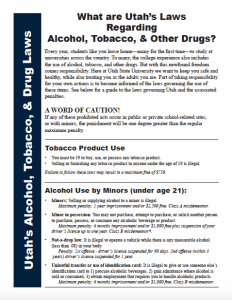
Next, I looked at the document and it’s rhetorical situation, asking myself “Who is the primary audience, and what is the document’s purpose?” Obviously, students at USU are the primary audience, and the document is supposed to educate them about the drug and alcohol laws. But I believed it was most pertinent to new students who have found themselves away from parental guidance for the first time and may be tempted to abuse that freedom. I decided it was important to address this audience personally. To do so, I toned down the language style of the original, and I wrote a conversational introductory section, using the pronoun “you” to make the document personal to each reader, explaining why the document should matter to them and what their responsibilities were.
Finally, I also addressed the graphic design aspect of the document, again looking specifically at the rhetorical situation of the design itself. I specifically designed it to be able to serve double-duty either as a stand-alone print brochure that could be given to students or as a direct link on USU’s Student Wellness Center’s website. Using Adobe InDesign, I reconfigured the document, adding a bold, eye-catching header on the first page, prominent sub-heads to make finding information quick and easy, and using simple but effective design elements such as graphic lines and the use of Aggie blue coloring to tie the document together into a cohesive whole.
Testimonial from my instructor:
“I forwarded your Comprehensive Editing Project to . . . the director of the USU Health and Wellness Center. . . and received the following message: ‘I forwarded the document file you sent from Tracy Jones to . . . my prevention specialist as well as to [the] Campus Police Chief. Both were enthusiastic in their review of her work. . . [They] would like to make that version available in some of [their] presentation work, as well as on the website. . .’ I foresee significant success for you as you continue in and graduate from the technical communication program. You have the superb combination of strong, natural ability for technical communication work plus phenomenal work ethic . . .”
 Tracy L. Jones