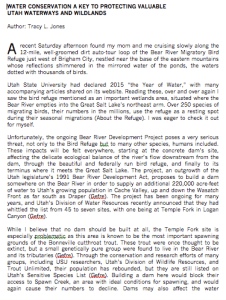
Op-Ed Article: The Bear River Development Project
This article was an assignment in a Western American Literature course I took, in support of my minor in American Studies. In this assignment, we were required to research a land issue that is specific to Utah and write a persuasive op-ed either in support of or against it.
The issue of water use in the arid Western US is always contentious, and the area of northern Utah where I live is no exception. As such, I chose to look at the proposed “Bear River Development Project” (BRDP) that would take Bear River waters from northern Utah and distribute them to communities as far as 100 miles south of us.
I’ve read many op-eds and letters to the editor that only present one impassioned side to an issue, but I know that there are always two sides to every story. Because of this, I did hours of research studying both sides of the BRPD debate in order to fully educate myself, reading letters to the editor, newspaper and media coverage regarding both the project itself and water use issues in general, and academic studies published by researchers at Utah State University who have conducted long-term research of the affected areas.
In writing my essay, I used a two-prong approach. First, I opened with a personal anecdote about a visit to the Bear River Migratory Bird Refuge, which will be affected if the project goes through. By doing this, I hoped to show readers not just the contentious, political side of the issue, but the personal effects as well and why the outcome of the political battle matters to me—and to them.
Next, I presented a balanced view of both sides of the issue that I learned through my research, then compared and contrasted the arguments to show how the “pro-BRPD” camp has made dubious claims and even contradicted themselves in the media records that I studied. Building upon my argument against this project, I then followed up with the academic studies that show not only the short-term but evidence for the dire long-term consequences for watersheds on both ends of the subject area.
Finally, I ended the essay by returning to my opening anecdote, bringing the argument full circle by using the rhetorical technique of pathos to appeal to the reader’s sense of what will be lost if the Bear River Development Project is enacted.
 Tracy L. Jones